
Spend Less Time in Tabs. Try the Sales Prospecting Team of Agents.
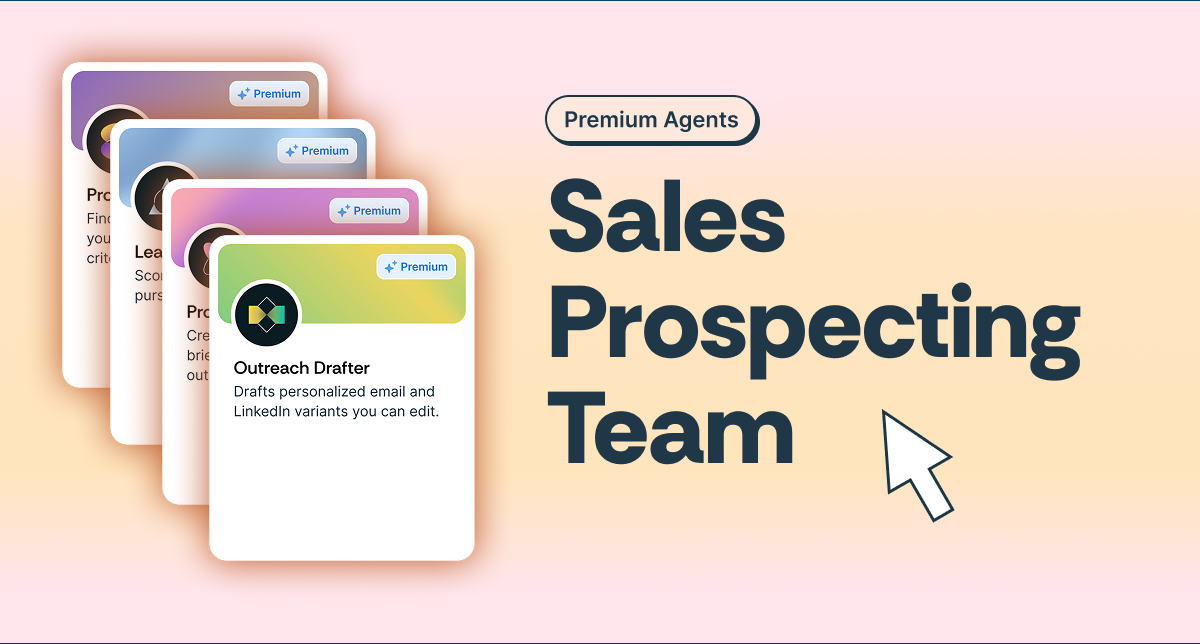
Meet the Sales Prospecting Team: A connected workflow of four agents that helps you find prospects, qualify, and draft personalized outreach in minutes.

Prospecting usually doesn’t fail because you don’t have the capabilities to do it. It fails in the handoffs.
You build a list. Then you research. Then you try to decide who’s worth pursuing. Then you open a blank page to draft outreach. Each step lives in a different tab, a different workflow, or a different mental model. Context gets lost. Criteria drift. Momentum slows.
Today, we’re launching the Sales Prospecting Team—a connected team of four agents designed to take you from:
“Who should I target?” to “Here’s a message I can send.”
Without stitching tools together, rebuilding your criteria every time, or starting from a blank page.
What Is the Sales Prospecting Team?
The Sales Prospecting Team is a bundled set of four connected agents:
- Prospect Finder – Finds and ranks prospects from your plain-language targeting criteria.
- Prospect Research – Creates structured prospect briefs with priorities and outreach angles.
- Lead Qualifier – Scores ICP fit and recommends Pursue, Nurture, or Pass.
- Outreach Drafter – Drafts personalized email and LinkedIn variants you can edit and send.
Individually, each agent solves a real problem. Together, they create a workflow.
Instead of isolated outputs, each step carries context forward—what you sell, who you sell to, what you’ve already learned—so the next step starts smarter than the last.
How the Team Works
Here’s what end-to-end prospecting looks like inside the Sales Prospecting Team:
1. Describe who you want.
Write your targeting criteria in plain language—role, industry, company size, geography, signals.
Before running, Prospect Finder shows how it interpreted your criteria so you can confirm or adjust. Then it generates a ranked shortlist.
2. Turn a name into a brief.
Prospect Researcher converts a person into a structured intelligence snapshot:
- Role and responsibilities
- Likely priorities
- Outreach angles
- Communication style cues
Not a raw dump—a brief designed for action.
3. Decide who to pursue.
Lead Qualifier scores ICP fit (0–100), assesses timing, and recommends:
- Pursue Now
- Nurture
- Pass
It includes transparent criteria breakdown and rationale, so you can validate or override recommendations with confidence.
4. Draft the first touch.
Outreach Drafter generates a ready-to-send outreach package:
- 2–3 email variants
- 1–2 LinkedIn messages
- Personalization signals surfaced for review
No blank page or generic templates. You get structured drafts grounded in real context.
How Prospecting Changes in Practice
When prospecting is connected instead of stitched together:
- Targeting gets reused instead of rebuilt.
- Research supports real decisions.
- Qualification becomes consistent and transparent.
- Outreach reflects upstream context automatically.
The result is less manual work and fewer “restart” moments. Instead of spending 25–35 minutes per prospect researching and drafting, you can move from targeting to message in minutes.
Most teams save 5–10 hours per week simply by reducing manual list building, re-researching, and blank-page writing.
One Team. One Workflow. $25/Month.
The full Sales Prospecting Team—all four agents, connected—is available for $25/month.
This team is especially useful for:
- Sales leaders who want consistent ICP application and clearer qualification decisions.
- Operators and founders who need prospecting to fit around everything else.
- Marketers and client-facing teams who need thoughtful outreach without hours of prep.
Because the outputs are structured and reviewable—fit scores, rationale, outreach variants—they’re easier to coach, compare, and improve over time. Prospecting becomes less dependent on individual “tab habits.”
If prospecting has felt fragmented, manual, or inconsistent, this is a simpler way to run it. Spend less time stitching together tools. Spend more time moving pipeline forward.


.png)