
10 AI Predictions for 2026 as AI Moves From Tool to Teammate
Ten bold predictions on where AI is heading in 2026—from onboarding and ROI to hiring, video, and trust. Join the debate and watch the full episode.

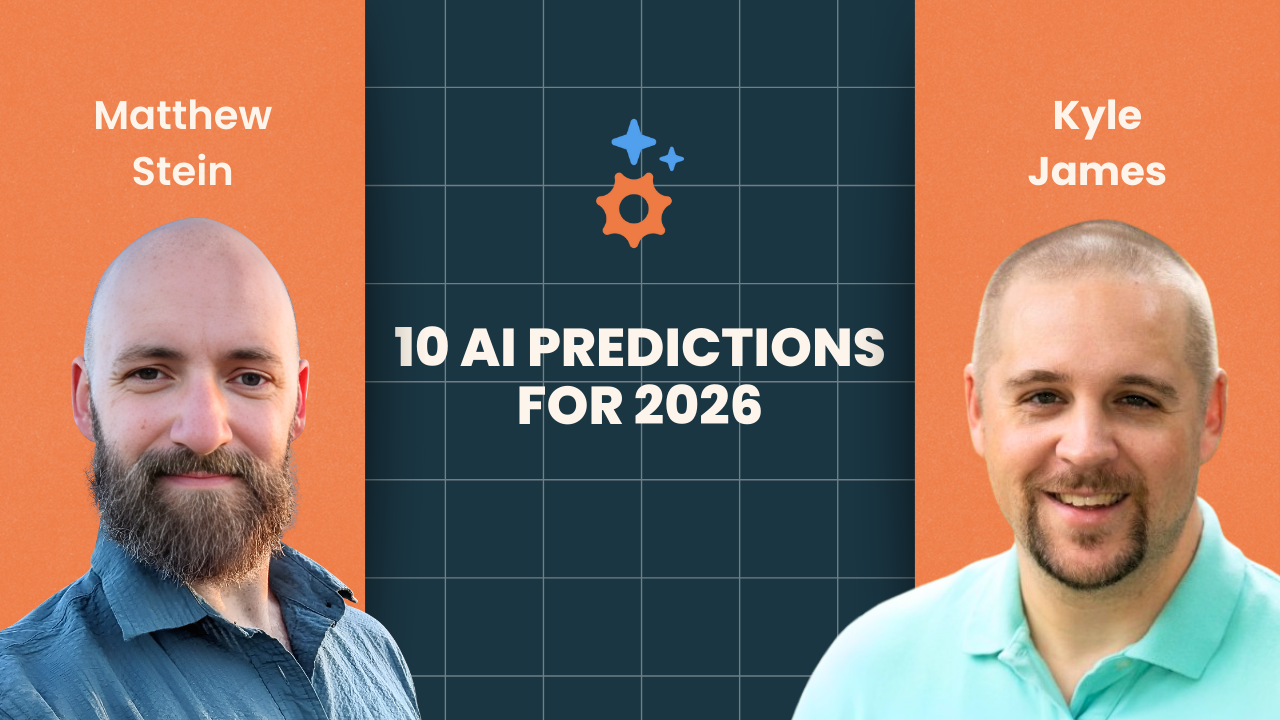
As we wrapped up 2025, we recorded a special predictions episode of Prompted. This was not a builder story in the traditional sense. It was a chance to pause, zoom out, and debate where AI is actually heading in 2026.
This post is the short version. The full episode goes much deeper, and if you care about the reasoning behind these calls, I strongly recommend watching it. Even more important, we want you in the YouTube comments telling us what we got right, what we got wrong, and what we missed.
Here are the ten predictions we covered.
1) AI onboarding becomes standard practice.
AI is moving from experimentation to operations. That shift changes everything.
Companies will stop treating AI like a tool you casually try and start treating it like something you onboard. Context, guardrails, training, review, and thresholds for trust all start to matter.
If AI is part of how work gets done, onboarding it becomes unavoidable.
2) Model training quality degrades, and buyer fatigue with new model releases sets in.
We intentionally grouped these because they represent two sides of the same coin.
On the supply side, models increasingly train on AI-generated content. That creates a real risk of outputs becoming derivative and average over time.
On the demand side, buyers are already showing signs of fatigue. For most people, text models are good enough. Incremental improvements are hard to notice, and version numbers are losing meaning.
Together, these trends suggest 2026 is less about better models and more about better application.
3) More GTM roles include AI in the title.
This one is already starting to show up.
Just like SEO and RevOps became formal roles, AI is moving from a skill expectation into job titles. We talked about AI GTM roles, AI ops, AI editors, and orchestration-focused positions that sit between strategy and execution.
The takeaway is simple. People who know how to direct AI will have leverage.
4) Personal context becomes portable.
I made a case that long-running memory and personalization are where real value lives.
That raises an obvious next question. What happens when users want to take that context with them from one tool to another?
Interoperability and context portability could become competitive battlegrounds as users resist starting from scratch every time they switch platforms.
5) AI resumes and portfolios become table stakes for hiring.
Everyone says they use AI now. That is no longer differentiating.
We both agreed that proof will matter more than claims. Agents you built. Workflows you designed. Real outputs you shipped.
In 2026, showing how you work with AI will matter as much as what you say you know.
6) 75% of marketing videos will be AI-generated.
This was one of the bolder calls.
Between cost reduction, speed, and creative experimentation, AI-generated video is going to flood marketing. Not because it's perfect, but because it is fast and cheap.
We also talked about the risk here. The teams that win will not try to make AI look real. They will lean into creative, surreal, obviously AI-driven storytelling that fits their brand.
7) PageRank-style authority signals make a comeback.
Hallucinations are still a real problem, especially as zero-click answers become the norm.
We debated whether something like PageRank, or a modern authority scoring system, makes a comeback inside LLM training or response generation. The goal would be simple: Reduce hallucinations and rebuild trust.
If trust becomes a differentiator, authority signals become valuable again.
8) Zero-party data gains momentum.
As cookies disappear and privacy pressure increases, companies will look for data users willingly provide.
Polls, preferences, surveys, and interactive inputs all fall into this category. Zero-party data gives users control while giving AI systems better signal.
It also ties directly back to onboarding, personalization, and trust.
9) Anthropic beats OpenAI to market with an ads platform.
This was a speculative but strategic prediction.
With IPO pressure and different incentives, we debated whether Anthropic might roll out an ads platform before OpenAI. Monetization strategies matter, and whoever figures this out first shapes how AI gets funded going forward.
This one will be very binary. Either it happens or it doesn't.
10) More than 70% of companies show zero ROI on AI implementations.
This was one of our most debated predictions.
MIT research suggests most AI pilots fail to deliver ROI today. We argued whether that improves meaningfully in 2026.
Kyle's position was that messy data, poor onboarding, and unclear ownership still hold most companies back. Individual productivity gains will be real, but company-wide ROI will remain elusive for many.
Bonus prediction: ChatGPT gets knocked off the top spot.
We ended with a wild and reckless bonus. Distribution beats product innovation over time. Platforms that own search, email, documents, and context have structural advantages over standalone tools.
If that shift happens, it will be obvious. And if it doesn't, we will happily eat crow in December.
Join the debate.
This post is not meant to be definitive. It's meant to start a conversation.
Watch the full episode. Hear the full reasoning. Then head to YouTube and tell us:
- Which predictions do you strongly agree with?
- Which ones do you think we're completely wrong about?
- What should be on the list for 2027?
Drop a comment. Push back, and add your own prediction. That's where the most valuable conversation begins.